Free forever, local, no account
The markdown workspace where humans and AI agents collaborate safely.
Comment on the words you're actually reading. Keep every version. Let your agents work the same documents without overwriting each other — all on plain .md files that stay yours, wherever they live.
npx -y draftmeshRequires Node 20 or newer. Prints a local URL — open it and the whole app is there. No account, nothing uploaded.
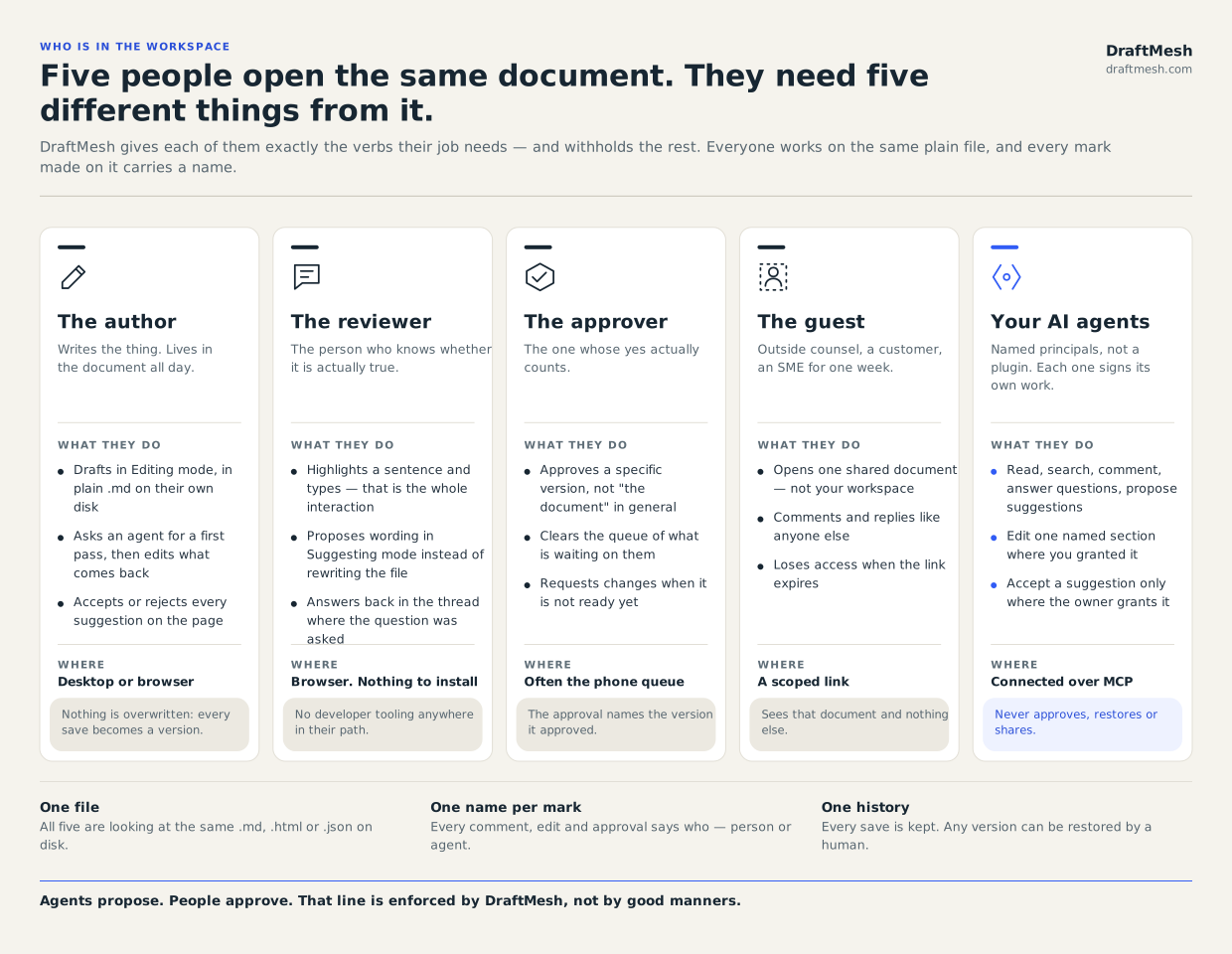
Who is in the workspace
You, your reviewers, and your agents — on one file.
Everyone gets exactly the actions their job needs, and no more — a reviewer never has to learn an editor, and no agent can approve its own work.
Why DraftMesh
Every other tool makes you trade something away.
Teams writing in markdown keep hitting the same three walls. DraftMesh removes all three.
01
Your work disappears quietly
02
You can't review what you're reading
03
Your agents step on each other
The contract
The file on your disk is the source of truth.
Not a row in our database. Not an export you have to remember to run. The actual markdown file, in a folder you picked, that any editor on earth can open.
Plain files, always
Markdown is the heart of it, alongside HTML pages and the JSON behind them. Open any of them in Vim, Obsidian, VS Code, a browser, or cat.
Comments travel with the document
Annotations live as invisible markers inside the markdown — send someone the file and the review context goes with it.
Offline-first, not offline-tolerant
The local app has no network dependency at all. Airplane, air gap, dead Wi-Fi: identical behaviour.
Leave whenever you want
There is no export step, because there is nothing to export from.
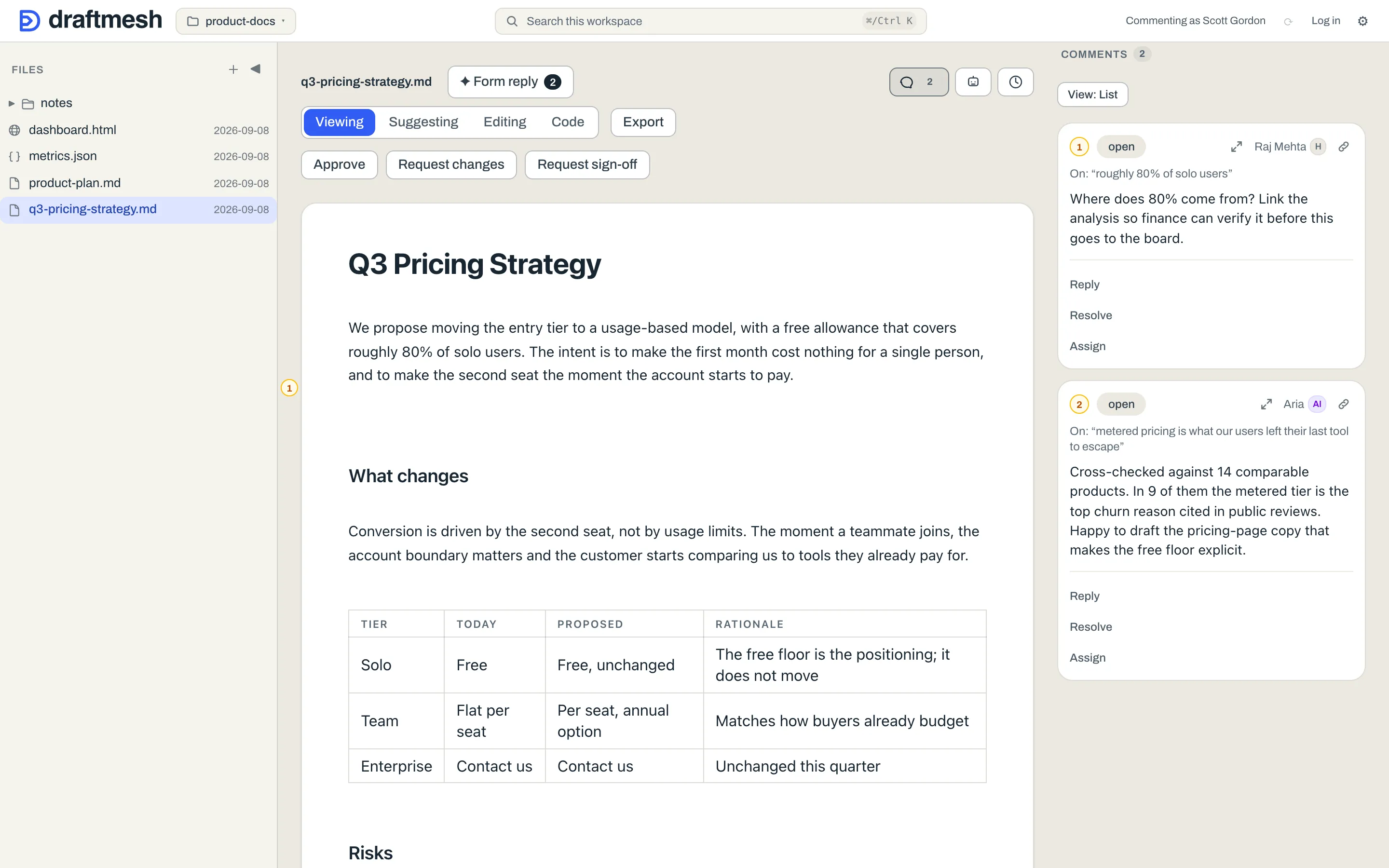
Q3 Pricing Strategy
We propose moving the entry tier to a usage-based model, with a free allowance that covers roughly 80% of solo users.
Raj · SME
Where does 80% come from? Link the analysis so finance can verify.
Conversion is driven by the second seat, not by usage limits — the moment a teammate joins, the account boundary matters.
Aria · Agent
Cross-checked against 14 comparable products. Suggested edit attached.
Where you fit
Start solo. Grow into a team.
DraftMesh is free forever for one person on one machine. When your documents need to leave it — synced to your own devices, or shared with a team — everything you've built comes with you.
Free forever
For solo builders
You run your own agent fleet on your own machine. You need honest attribution between you and your agents, history you can roll back, and zero setup.
See the free local app →
Paid tiers
For teams
You're pulling cross-functional reviewers and outside stakeholders into a document. You need verified identity, sharing, and attribution that holds across a trust boundary.
See team collaboration →
In between — just want your own documents on your own devices? That's the Individual tier.
Security & enterprise
Built for documents you can't afford to leak.
Content that never leaves your machine can't be breached in ours. The Team tier adds an append-only audit trail, and the Enterprise tier adds SSO — without giving that up.
Local by default
Encrypted in transit and at rest
Single sign-on
Append-only audit log
What isn't built yet is written down too — see the security posture FAQ and the audit log guide for today's limits, stated plainly.
Questions people ask before downloading
Is DraftMesh really free?
Yes. The local app is free forever — no account, no credit card, no trial clock. You only pay when your documents leave your machine: the Individual tier syncs your own documents across your own devices, and the Team tier adds collaboration with other people.
Where are my documents stored?
In a folder you choose, as ordinary files — .md for prose, plus .html and .json if you use them. DraftMesh reads and writes the same plain markdown any other editor can open. Nothing is uploaded in the free local app, and there is no proprietary database holding your work hostage.
What happens to my documents if I stop using DraftMesh?
Nothing. Your files were already plain markdown, HTML, and JSON in a normal folder on your disk. Uninstalling leaves every document — and every comment, which lives inside the file — exactly where it was.
How is this different from Notion, Confluence, or Google Docs?
Those tools store your content in their database and give you an export button. DraftMesh treats the file on your disk as the source of truth, so your documents stay portable, diffable, and readable by your own tools and AI agents. It also works fully offline.
Do I need to be technical to use DraftMesh?
No. Reviewers see a document and the comments on it. History is a list of saved versions with a name and a time on each, and restore is one click — nothing borrowed from developer tooling.
Does DraftMesh only handle markdown?
Markdown is the primary case. An .html document also renders as a real page — a dashboard, a report — that stakeholders can comment on and approve, and a .json data file is versioned alongside it. Three file types today, and not where we intend to stop.
Can AI agents use DraftMesh?
Yes — agents are first-class users, not an add-on. Multiple agents can read and write the same documents through a coordinated interface that prevents them from overwriting each other, and every change is attributed to the specific agent or person who made it.
Good work. Woven together.
The local app is free forever — no account, no upload, no card. Your markdown never leaves your machine.
Free forever, local, no account